The Battle of Gorodetschna
Russian Forces at Gorodetschna
The Russian forces consisted of the third army of General of the Cavalry Tormasov,
less the detached groups of Czaplitz, Malissino and Prince Khovanski. At the appearance
of the numerically superior forces of the Austrian Corps of Schwarzenberg and
the 7th Corps of Reynier, Tormasov concentrated the corps of Markov and Kamenski
and Lambert's Group at Gorodetschna, a total of 18,000 men.
Corps Kamenski
Commanded by Major-General Prince Stcherbatov
Vlaniminski Infantry
Tambovski Infantry
Dneprovski Infantry
Kostromski Infantry
28th Rifles
Starodoubovski Dragoons
Taganrogski Dragoons
Tverski Dragoons
12 guns
Corps Markov
Nachebourgski Infantry
Vitebski Infantry
Kozlovski Infantry
Riajski Infantry
10th Rifles
Pavlogradski Hussars
4 squadrons of the Tartar Lancers
Kalmouck Cosacks
6 guns
Count Lambert
Kourinski Infantry
14th Rifles
Alexandriiski Hussars
6 guns
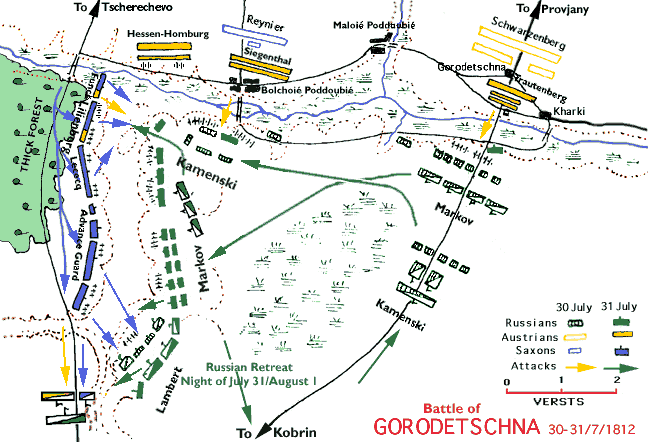
The Russian position was covered in front and to the right by a stream and difficult
marsh, and on the left by a dense forest. The front could only be accessed by
three passages where foot roads ran across the stream and its branches. The night
of 30 July Schwarzenberg was before Gorodetschna and Reynier was at Jabino, with
a total of 40,000 men between them. The Russian position was held by the Corps
of Kamenski with the infantry in line; the 28th Rifles covering the wings, and
the dragoons in an angle on the left, observing the plain. Two battteries of 12
pieces opened a heavy fire on the left passage from Poddoubie to prevent the Saxon
infantry, which had just appeared, from traversing the marsh.
On July 31 Schwarzenberg decided to turn the Russian left with the Corps of Reynier
and two Austrian brigades. In the advance guard there was a battalion of light
infantry, a battery of light artillery, the Polentz Chevaulegers, the Prince Clemens
Lancers and the Saxon Hussars, supported by the Austrian Hohenzollern and O'Reilly
Chevaulegers. They were followed in order by the Division Lecocq and the Brigade
Sahr (of Division Funck). The Austrian Division Siegenthal was approaching the
passage from Poddoubie in support.
Tormasov now turned the front of the Corps Kamenski to the left, leaving the heights
across from Poddoubie defended only by the Vladimirski Infantry. The Corps Kamenski
faced the forest, from which Reynier had commenced deploying his troops. The Russian
infantry formed a line and the batallion of the 28th Rifles was placed between
the old and new positions to maintain contact with the Vladimirski Infantry. A
battery of 24 pieces was set up at the new position.The Starodoubevski and Taganrogski
Dragoons remained in the rear, echeloned to the left.
Reynier's front was being ceaselessly reinforced and expanded to its right with
-- from right to left -- the Saxon Advance Guard, Division Lecocq, Brigade Lilienberg
and the Division Funck which abutted on the swamp. The Brigade Hessen-Homburg
(of the Division Bianchi) and Austrian cavalry were behind the marsh around Poddoubie
on the route to Tscherechevo, the Division Siegenthal was at Poddoubie and the
Division Trautenberg and the rest of the Austrian cavalry was at Gorodetchna.
Tormasov ordered the Corps of Markov to deploy to the left of Kamenski's Corps.
The troops of Count Lambert were arrayed further to the left to restrain Reynier's
advance. Lambert occupied the heights in front of Reynier's right with the 14th
Rifles and Alexandriiski Hussars, while the Kourinski Infantry was return to Markov.
Between Markov (formed in two lines) and Lambert were placed 4 squadrons of the
Tartar Lancers and the Kalmouck Cosack. On Lambert's left were the Pavlogradski
Hussars. This left the passage from Gorodetschna to be defended against Trautenberg
only by the Riajski Infantry, the Tverski Dragoons and a battery of guns.
We can see here both the cautious nature of Austrian generals and, perhaps, the
agreed upon avoidance of serious combat between Austria and Russia. Certainly
Tormasov should never have been able to disengage an entire corps, march it across
the front of the enemy (even if covered by a marsh) and quietly reform on a new
flank. When Massena did that at Wagram it was regarded as a masterly feat of a
great general. The point of a pinning attack, as Schwarzenberg was doing with
Trautenberg's Division, is to tie up as many enemy troops as possible with pressing
attacks. Instead, two entire Austrian divisions were tied down by one regiment
of Russian infantry each. This enabled Tormasov to use his smaller forces with
great effect.
The Hohenzollern and Polenz Chevaulegers, attempting to turn Lambert's left, were
attacked in front by the Pavlogradski Hussars and in the flank and rear by the
Alexandriiski Hussars and repulsed. Against the right of the Russian line Reynier
sent the Division Funck formed in columns and supported by two batteries of 6
guns, by the artillery of Lecocq and by a battery of Austrian guns which was at
Poddoubie. The attack was repulsed and the 2nd Saxon Light Infantry were forced
into square by the Russian dragoons. In the evening the Division Funck attacked
again, led by the Austrian Alvinzy Infantry Regiment of the Brigade Lilienberg
and the light infantry of the Division Lecocq. Meanwhile, a battalion of the Colorado-Mansfeld
Regiment of the Brigade Hessen-Homburg was unable to cross the marsh from Poddoubie
in support of the attack. The other battalion of the Colorado-Mansfeld Regiment
was attached to the Division Funck and for a time held the heights across from
Poddoubie, but it was later repulsed when Tormasov sent in the Nachebourgski,
Viotebski and Kozlovski Infantry and 4 squadrons of the Tartar Lancers. At the
same time the 10th Rifles attacked the rear of the column of Saxons which was
attacking Markov's left flank. The Riajski Infantry covering the passage from
Gorodetschna successfully resisted all the tentative attacks by the Division Trautenberg
across the swamp throughout the day.
The Russians now were hard pressed to maintain all their fronts against superior
forces. Despite repulsing all attacks with vigorous counter-attacks the Russian
army was feeeling the constant pressure of concentric attacks by Schwarzenberg
and Reynier. Realizing that the situation was dangerous and his position untenable
Tormasov retired on Kobrin during the night of 31 July/1 August.
Casualties were some 4,000 for the Russians and 5,000 for the Austrian-Saxon army.
This one battle represented some 60% all all Austrian battlefield casualties in
the 1812 campaign, reflecting both the intense nature of the conflict and how
well the Austrians and Russian avoided each other most of the time. Napoleon was
impressed enough with Schwarzenberg's handling of the battle that , at his request,
Schwarzenberg was promoted to Field Marshal by Emperor Francis.
From a Russian source.
Return to Main Page
Return to Campaign History