The Austrian Campaign under FM Schwarzenberg in 1812
In 1812 Austria found itself in an awkward position. A leader of conservative
monarchy, Austria had most consistently opposed the French revolutionaries who
murdered Marie Antoinette, Archduchess of Austria and Queen of France, and sought
to overturn the established monarchies of Europe. Repeatedly defeated by France,
most recently in 1809 when she fought the French alone, Austria was forced to
seek an understanding with Napoleon. This resulted in 1810 with the Marriage of
Napoleon to Marie Louise of Austria and the birth of the King of Rome -- heir
to the French throne and an Austrian archduke. In 1812 when Napoleon invaded Russia,
a traditional ally of Austria, the Austrians were forced to send a corps to the
Grande Armée to support their son in law. Much thought had to be given
to showing enough zeal to please Napoleon without angering Austria's past and
future allies against him.
The Austrian Corps was in operation on the southern front of the Grande Armée
in Poland and White Russia, protecting the western bases and lines of communication
for the main army. This was most fortunate as it precluded the Austrian corps
from making the disasterous march to Moscow. General Reynier and his Saxon Corps
were attached, with FM Schwarzenberg in overall command. General Reynier filled
the difficult double role of corps commander and ranking French "adviser" to keep
an eye on the Austrians. Although they sometimes fought together, as at Gorodetschna,
they more often worked as independent corps probing aginst the encircling Russians.
This was largely a cavalry campaign of scout, probe and push. As a consequence
there were numerous small actions which sometimes resulted in hundreds of casualties.
The cavalry service page lists many of these small actions.
Battles were few, although there were many skirmishes with the Russian forces
of the Southern Army that were observing and pressing the corps. Supposedly there
was an understanding between Vienna and St. Petersberg that the Austrians would
not seriously engage the Russians, nor would the Russians press the Austrian Corps
more than appearances required. In the event, the Austrians fought very well indeed,
and the Russian government felt impelled to lodge a strong protest at the Austrian
court.
On the 27th of July Count Tormasov surprised an isolated corps of 2,000 Saxons
at Kabrin and drove them off in retreat. This led to the most noteworthy battle
was of the campaign, Gorodetchna (which the Austrians
called "Podubnie"), where the Russians under Tormasov were defeated on 31 July
and followed to the Styr River. In this battle Infantry Regiments l9 Alvinzy and
33 Colloredo-Mansfeld were noted for their severe struggle with the Russian infantry;
and the O'Reilly and Hohenzollern Chevaulegers were instrumental in winning the
battle with their turning of the Russian left flank. This activity of the Russians,
and in particular a thrust by General Lambert, led to the formation of the Volhynie
Provisional Division by the Grand Duchy of Warsaw that campaigned along the
Volhynie.
 Some four weeks later the Russians
were reinforced by the Army of Moldavia under Admiral Tschitshagov, and Schwarzenberg
fell back to the Bug river in central Poland. By this time the Austrian Army was
starting to feel the effects of the breakdown of the Grande Armée's supply
system. Discipline began to be a problem, and cases of looting were sternly suppressed.
A typical action fought at this time is the Battle of Voskrinitza.
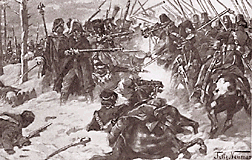
With Tschitshagov covering the Austrian Corps Tormasov was able to move on Krasnoie
(shown in the painting on the left) and block the route to Orscha without a reply
from French forces. This determined the retreat from Moscow by the Grande Armée.
Some four weeks later the Russians
were reinforced by the Army of Moldavia under Admiral Tschitshagov, and Schwarzenberg
fell back to the Bug river in central Poland. By this time the Austrian Army was
starting to feel the effects of the breakdown of the Grande Armée's supply
system. Discipline began to be a problem, and cases of looting were sternly suppressed.
A typical action fought at this time is the Battle of Voskrinitza.
With Tschitshagov covering the Austrian Corps Tormasov was able to move on Krasnoie
(shown in the painting on the left) and block the route to Orscha without a reply
from French forces. This determined the retreat from Moscow by the Grande Armée.
At the end of October the Austrians were ordered to Minsk to protect the retreat
of the main army, which city was, in fact, their original objective. Another battle
was fought with the Russians at Wolkowisk on 15-16 November, where Reynier and
Schwarzenberg defeated Lt. Gen. Sacken and the left wing of Tschitschkov's corps.
However, with Schwarzenberg diverted to aid Reynier at Wolkowisk, Tschitshagov
was able to capture Minsk and its valuable depots on 16 November. At this time
Count Lambert was detached to help oppose the French retreat from Moscow. He was
wounded in the attack on Borisov which permitted the Russians to occupy the Berezina
River crossing and limit the French retreat to only one route. The ability of
Tormasov's Corps to detach itself and move against the French main army is a sign
of the ultimate failure of Schwarzenberg's Corps to achieve its real goal -- protecting
the Grande Armé from flank attack in the south.
In late November the Austrians and Saxons withdrew into winter quarters at Byalistok
under a verbal agreement with the Russians. This marked the effective end of the
service of the Austrian Corps in the 1812 campaign. Of some 30,000 Austrians in
the corps, 7,000 were killed in battle and 4,000 died of disease and exposure.
Although exact figures are not available the Saxons also suffered serious losses
in men, including the death of Major General Christoph Freiherr von Gutschmid.
With the obvious defeat of the Grande Armée the Hofkriegsrat in Vienna
ordered Schwarzenberg to extricate his corps from the eastern front. On 30 January,
1813 "considering the rigorous season and other circumstances equally pressing"
Schwarzenberg signed a formal convention of neutrality with the Russians and withdrew
his corps to Galicia in February. There he handed command over to General Frimont
and returned to Vienna.
By Stephen Herold, M.A., Ph.C.
Return to Main Page
The Volhynie campaign